President Obama is asking Democrats to “grind it out” and stick with him and his embattled new entitlement program despite a disastrous launch and new revelations that he misled voters with claims about being able to keep their insurance.
That may work for the blue-state true believers the president spoke to in Boston on Wednesday, but “grind it out” isn’t exactly an ideal swing-state strategy. With approval for Obama and ObamaCare damaged in the rollout crash and concerns mounting rather than receding, the president’s request is a substantial one. “Grind it out” means grinding down their own poll numbers.
There's a serious love affair going on between Hollywood and the art world. Exhibit A: In May, a charity art auction organized by Leonardo DiCaprio raised $38 million in one night and set sales records for 13 artists. Exhibit B: A month later, Paramount chairman and CEO Brad Grey stepped up to join Brian Grazer, Michael Lynton and Bryan Lourd on the entertainment-heavy board of LACMA. Exhibit C: the artist-actor hybrid that is James Franco.
Suddenly, everyone in town seems to have gone collecting mad. In an industry once dominated by a few powerful collectors (David Geffen, Michael Ovitz), there's now a deeper and younger bench of players passionate about art, from agents (CAA's Joel Lubin, UTA's Pete Franciosa) and actors (Neil Patrick Harris) to execs (HBO's Michael Lombardo) and managers (Brillstein Entertainment Partners' JoAnne Colonna, Scooter Braun). "There's a lot of people in the industry who have great taste who are being exposed to great art," says producer and LACMA board member Steve Tisch. "I know a number of collectors who have gotten into collecting in the past five or 10 years, and their passion for building their collection is fantastic."
It's a convergence that was inevitable. As the entertainment world's 1 percent have grown more sophisticated -- and want the world (or at least their peers) to know it -- the L.A. art world is on the rise, generating buzz in Hollywood's backyard. Masters such as John Baldessari and Ed Ruscha have been joined by a swelling rank of wunderkinds who sell out shows (Mark Grotjahn, whose paintings go at auction for more than $1 million, sold out his last show at Culver City's Blum & Poe before it opened) and earn MacArthur fellowships (painter Mark Bradford) and public followings (photographer Catherine Opie, street artist Shepard Fairey). And L.A. is on a cultural building spree, which includes Beverly Hills' new Wallis Annenberg Center for the Performing Arts, Eli Broad's Broad Museum due to open in 2014 across from MOCA and the upcoming Academy Museum.
Entertainment players are giving back, too -- not just by serving on boards, but with hefty donations, including Tisch's $467,500 contribution to LACMA to buy ChristianMarclay's film The Clock and former UPN chief Dean Valentine's gift of 50 important sculptures to the Hammer. "L.A. is finally a place that people are proud to call home," says Hammer Museum director Ann Philbin, whose board boasts UTA's Jeremy Zimmer and Peter Benedek, CAA's Michael Rubel, Gersh's Bob Gersh and WME's George Freeman. "It's no longer a place they're passing through, a place they have to live in. I think a lot of these [industry leaders] are simply becoming better citizens, they're starting to care about the cultural vitality of the city. The robust connections between the art world and the film industry are just getting stronger and stronger." -- MAXWELL WILLIAMS
Written by Gary Baum, Merle Ginsberg, Marissa Gluck, Tatiana Siegel, Rebecca Sun, Kate Sutton and Michael Walker. Karen Rhee contributed to this feature.
Geoengineering the climate could reduce vital rains
PUBLIC RELEASE DATE:
31-Oct-2013
[
| E-mail
]
Share
Contact: David Hosansky
hosansky@ucar.edu
303-497-8611
National Center for Atmospheric Research/University Corporation for Atmospheric Research
Simone Tilmes
tilmes@ucar.edu
303-497-1445
NCAR
John Fasullo
fasullo@ucar.edu
303-497-1712
NCAR
BOULDERAlthough a significant build-up in greenhouse gases in the atmosphere would alter worldwide precipitation patterns, a widely discussed technological approach to reduce future global warming would also interfere with rainfall and snowfall, new research shows.
The international study, led by scientists at the National Center for Atmospheric Research (NCAR), finds that global warming caused by a massive increase in greenhouse gases would spur a nearly 7 percent average increase in precipitation compared to preindustrial conditions.
But trying to resolve the problem through "geoengineering" could result in monsoonal rains in North America, East Asia, and other regions dropping by 5-7 percent compared to preindustrial conditions. Globally, average precipitation could decrease by about 4.5 percent.
"Geoengineering the planet doesn't cure the problem," says NCAR scientist Simone Tilmes, lead author of the new study. "Even if one of these techniques could keep global temperatures approximately balanced, precipitation would not return to preindustrial conditions."
As concerns have mounted about climate change, scientists have studied geoengineering approaches to reduce future warming. Some of these would capture carbon dioxide before it enters the atmosphere. Others would attempt to essentially shade the atmosphere by injecting sulfate particles into the stratosphere or launching mirrors into orbit with the goal of reducing global surface temperatures.
The new study focuses on the second set of approaches, those that would shade the planet. The authors warn, however, that Earth's climate would not return to its preindustrial state even if the warming itself were successfully mitigated.
"It's very much a pick-your-poison type of problem," says NCAR scientist John Fasullo, a co-author. "If you don't like warming, you can reduce the amount of sunlight reaching the surface and cool the climate. But if you do that, large reductions in rainfall are unavoidable. There's no win-win option here."
The study appears in an online issue of the Journal of Geophysical Research: Atmospheres, published this week by the American Geophysical Union. An international team of scientists from NCAR and 14 other organizations wrote the study, which was funded in part by the National Science Foundation (NSF), NCAR's sponsor. The team used, among other tools, the NCAR-based Community Earth System Model, which is funded by NSF and the Department of Energy.
Future carbon dioxide, with or without geoengineering
The research team turned to 12 of the world's leading climate models to simulate global precipitation patterns if the atmospheric level of carbon dioxide, a leading greenhouse gas, reached four times the level of the preindustrial era. They then simulated the effect of reduced incoming solar radiation on the global precipitation patterns.
The scientists chose the artificial scenario of a quadrupling of carbon dioxide levels, which is on the high side of projections for the end of this century, in order to clearly draw out the potential impacts of geoengineering.
In line with other research, they found that an increase in carbon dioxide levels would significantly increase global average precipitation, although there would likely be significant regional variations and even prolonged droughts in some areas.
Much of the reason for the increased rainfall and snowfall has to do with greater evaporation, which would pump more moisture into the atmosphere as a result of more heat being trapped near the surface.
The team then took the research one step further, examining what would happen if a geoengineering approach partially reflected incoming solar radiation high in the atmosphere.
The researchers found that precipitation amounts and frequency, especially for heavy rain events, would decrease significantly. The effects were greater over land than over the ocean, and particularly pronounced during months of heavy, monsoonal rains. Monsoonal rains in the model simulations dropped by an average of 7 percent in North America, 6 percent in East Asia and South America, and 5 percent in South Africa. In India, however, the decrease was just 2 percent. Heavy precipitation further dropped in Western Europe and North America in summer.
A drier atmosphere
The researchers found two primary reasons for the reduced precipitation.
One reason has to do with evaporation. As Earth is shaded and less solar heat reaches the surface, less water vapor is pumped into the atmosphere through evaporation.
The other reason has to do with plants. With more carbon dioxide in the atmosphere, plants partially close their stomata, the openings that allow them to take in carbon dioxide while releasing oxygen and water into the atmosphere. Partially shut stomata release less water, so the cooled atmosphere would also become even drier over land.
Tilmes stresses that the authors did not address such questions as how certain crops would respond to a combination of higher carbon dioxide and reduced rainfall.
"More research could show both the positive and negative consequences for society of such changes in the environment," she says. "What we do know is that our climate system is very complex, that human activity is making Earth warmer, and that any technological fix we might try to shade the planet could have unforeseen consequences."
###
The University Corporation for Atmospheric Research manages the National Center for Atmospheric Research under sponsorship by the National Science Foundation. Any opinions, findings and conclusions, or recommendations expressed in this publication are those of the author(s) and do not necessarily reflect the views of the National Science Foundation.
About the article
Title: The hydrological impact of geoengineering in the Geoengineering Model Intercomparison Project
Authors: Simone Tilmes, John Fasullo, Jean-Francois Lamarque, Daniel R. Marsh, Michael Mills, Kari Alterskjr, Helene Muri, Jn E. Kristjnsson, Olivier Boucher, Michael Schulz, Jason N. S. Cole, Charles L. Curry, Andy Jones, Jim Haywood, Peter J. Irvine, Duoying Ji, John C. Moore, Diana B. Karam, Ben Kravitz, Philip J. Rasch, Balwinder Singh, Jin-Ho Yoon, Ulrike Niemeier, Hauke Schmidt, Alan Robock, Shuting Yang, and Shingo Watanabe
Publication:Journal of Geophysical Research: Atmospheres
On the Web
For news releases, images, and more:
http://www.ucar.edu/atmosnews
[
| E-mail
Share
]
AAAS and EurekAlert! are not responsible for the accuracy of news releases posted to EurekAlert! by contributing institutions or for the use of any information through the EurekAlert! system.
Geoengineering the climate could reduce vital rains
PUBLIC RELEASE DATE:
31-Oct-2013
[
| E-mail
]
Share
Contact: David Hosansky
hosansky@ucar.edu
303-497-8611
National Center for Atmospheric Research/University Corporation for Atmospheric Research
Simone Tilmes
tilmes@ucar.edu
303-497-1445
NCAR
John Fasullo
fasullo@ucar.edu
303-497-1712
NCAR
BOULDERAlthough a significant build-up in greenhouse gases in the atmosphere would alter worldwide precipitation patterns, a widely discussed technological approach to reduce future global warming would also interfere with rainfall and snowfall, new research shows.
The international study, led by scientists at the National Center for Atmospheric Research (NCAR), finds that global warming caused by a massive increase in greenhouse gases would spur a nearly 7 percent average increase in precipitation compared to preindustrial conditions.
But trying to resolve the problem through "geoengineering" could result in monsoonal rains in North America, East Asia, and other regions dropping by 5-7 percent compared to preindustrial conditions. Globally, average precipitation could decrease by about 4.5 percent.
"Geoengineering the planet doesn't cure the problem," says NCAR scientist Simone Tilmes, lead author of the new study. "Even if one of these techniques could keep global temperatures approximately balanced, precipitation would not return to preindustrial conditions."
As concerns have mounted about climate change, scientists have studied geoengineering approaches to reduce future warming. Some of these would capture carbon dioxide before it enters the atmosphere. Others would attempt to essentially shade the atmosphere by injecting sulfate particles into the stratosphere or launching mirrors into orbit with the goal of reducing global surface temperatures.
The new study focuses on the second set of approaches, those that would shade the planet. The authors warn, however, that Earth's climate would not return to its preindustrial state even if the warming itself were successfully mitigated.
"It's very much a pick-your-poison type of problem," says NCAR scientist John Fasullo, a co-author. "If you don't like warming, you can reduce the amount of sunlight reaching the surface and cool the climate. But if you do that, large reductions in rainfall are unavoidable. There's no win-win option here."
The study appears in an online issue of the Journal of Geophysical Research: Atmospheres, published this week by the American Geophysical Union. An international team of scientists from NCAR and 14 other organizations wrote the study, which was funded in part by the National Science Foundation (NSF), NCAR's sponsor. The team used, among other tools, the NCAR-based Community Earth System Model, which is funded by NSF and the Department of Energy.
Future carbon dioxide, with or without geoengineering
The research team turned to 12 of the world's leading climate models to simulate global precipitation patterns if the atmospheric level of carbon dioxide, a leading greenhouse gas, reached four times the level of the preindustrial era. They then simulated the effect of reduced incoming solar radiation on the global precipitation patterns.
The scientists chose the artificial scenario of a quadrupling of carbon dioxide levels, which is on the high side of projections for the end of this century, in order to clearly draw out the potential impacts of geoengineering.
In line with other research, they found that an increase in carbon dioxide levels would significantly increase global average precipitation, although there would likely be significant regional variations and even prolonged droughts in some areas.
Much of the reason for the increased rainfall and snowfall has to do with greater evaporation, which would pump more moisture into the atmosphere as a result of more heat being trapped near the surface.
The team then took the research one step further, examining what would happen if a geoengineering approach partially reflected incoming solar radiation high in the atmosphere.
The researchers found that precipitation amounts and frequency, especially for heavy rain events, would decrease significantly. The effects were greater over land than over the ocean, and particularly pronounced during months of heavy, monsoonal rains. Monsoonal rains in the model simulations dropped by an average of 7 percent in North America, 6 percent in East Asia and South America, and 5 percent in South Africa. In India, however, the decrease was just 2 percent. Heavy precipitation further dropped in Western Europe and North America in summer.
A drier atmosphere
The researchers found two primary reasons for the reduced precipitation.
One reason has to do with evaporation. As Earth is shaded and less solar heat reaches the surface, less water vapor is pumped into the atmosphere through evaporation.
The other reason has to do with plants. With more carbon dioxide in the atmosphere, plants partially close their stomata, the openings that allow them to take in carbon dioxide while releasing oxygen and water into the atmosphere. Partially shut stomata release less water, so the cooled atmosphere would also become even drier over land.
Tilmes stresses that the authors did not address such questions as how certain crops would respond to a combination of higher carbon dioxide and reduced rainfall.
"More research could show both the positive and negative consequences for society of such changes in the environment," she says. "What we do know is that our climate system is very complex, that human activity is making Earth warmer, and that any technological fix we might try to shade the planet could have unforeseen consequences."
###
The University Corporation for Atmospheric Research manages the National Center for Atmospheric Research under sponsorship by the National Science Foundation. Any opinions, findings and conclusions, or recommendations expressed in this publication are those of the author(s) and do not necessarily reflect the views of the National Science Foundation.
About the article
Title: The hydrological impact of geoengineering in the Geoengineering Model Intercomparison Project
Authors: Simone Tilmes, John Fasullo, Jean-Francois Lamarque, Daniel R. Marsh, Michael Mills, Kari Alterskjr, Helene Muri, Jn E. Kristjnsson, Olivier Boucher, Michael Schulz, Jason N. S. Cole, Charles L. Curry, Andy Jones, Jim Haywood, Peter J. Irvine, Duoying Ji, John C. Moore, Diana B. Karam, Ben Kravitz, Philip J. Rasch, Balwinder Singh, Jin-Ho Yoon, Ulrike Niemeier, Hauke Schmidt, Alan Robock, Shuting Yang, and Shingo Watanabe
Publication:Journal of Geophysical Research: Atmospheres
On the Web
For news releases, images, and more:
http://www.ucar.edu/atmosnews
[
| E-mail
Share
]
AAAS and EurekAlert! are not responsible for the accuracy of news releases posted to EurekAlert! by contributing institutions or for the use of any information through the EurekAlert! system.
LONG BEACH, Calif. -- As sweat dripped through his dreadlocks after a spirited workout on Thursday, Daniel Straus declared himself a happy man.
"Fight week is awesome," the American Top Team fighter said. "I live for this s---. I love to compete."
Straus, who challenges Pat Curran for the Bellator featherweight title on Saturday's main card at Long Beach Arena, hasn't fought for more than a year.
"To be out for so long, it sucks. To know that you're supposed to be doing one thing, .... I've been waiting and itching for my time to fight."
The Cincinnati native has been out of action, but that doesn't mean he's been out of the headlines. In a tumultuous late-winter span, Straus first had to pull out of the originally planned April 4 date against Curran due to a broken hand suffered in training. Then he was arrested in Ft. Lauderdale, Fla., and charged with driving with a suspended license and possession of marijuana, synthetic cannabis, and ecstasy.
The 29-year old Straus eventually reached a plea deal in order to receive probation and stay out of prison.
The way Straus sees it, the adversity he faced this year will only make him stronger as he goes to meet Curran.
"I just rolled with the punches," Straus said. "My hand held up through rehab, I dealt with my issues and kept pursuing my dream I'm here for. I'm here to be a world champion. Ups and downs don't bother me, ins and out don't bother me."
What did bother him, though, was the way his arrest was portrayed.
"It wasn't me just in the car," Straus said. "It didn't come out in the media because nobody knew that. So they didn't know it wasn't solely me. But that wasn't how it came out. It was heartbreaking to see how it did come out and how people portrayed it. I kind of took offense to the fact that no one came to me and asked me my side. Everyone just wanted to run and report what they read somewhere else. No one ever came and got it out of my mouth. That was heartbreaking."
With his troubles just about in his rear-view mirror, Straus can focus on his bout with Curran. This is a rematch of a 2009 match in Illinois contested in the XFO promotion, won by Curran on a second-round knockout.
Straus views the loss as the most important learning experience of his career. Since that time, he's won 17 of 18 fights.
"I can't go to that fight, examine that fight, and try to fight him again off that fight," Straus said. "I'll lose, again. Pat can't watch that fight, examine that fight, and fight me again. He'll take the ass-whipping I got that night. We're both two different fighters from the time I first met. We've grown as people, we've grown as fighters."
In fact, he feels so much has changed since that time, there's almost no point in going back and looking at the tape of the first fight.
"It really opened my eyes as to the sport. Since that fight of won 17 of 18 fights, I went on a two-year winning streak of 12 fights. That fight changed me because going into that fight I knew I could beat Pat. And I got beat. So I started taking this sport seriously."
Curran, meanwhile, returned the sentiment.
"He's so much better, so much more of a complete fighter than he was for our first fight," Curran said Thursday. "I'm better, he's better, I'm looking at this like a brand-new challenge, not like a rematch."
Win or lose, Straus is just glad he's back doing what he loves.
"I love this sport, it's been good to me," Straus said. "Being an athlete's been good to me. Sports have always been my savior. I've always been in and out of this, in and out of that, but I've always come back to sports. It's good. I don't want to be that guy that's losing 12 in a row and fighting for a paycheck."
This uplifting documentary delivers a compelling human interest story from a still traumatized Rwanda.
Directors
Lisa Fruchtman, Rob Fruchtman
There are not one but two compelling human interest stories on display in Sweet Dreams, the new documentary by the sibling filmmaking team of Lisa Fruchtman and Rob Fruchtman. Both involve the indomitable Rwandan woman Kiki Katese, who ten years after the horrendous 1994 genocide founded the country’s first all-female drumming troupe. Several years later, she embarked on another seemingly quixotic venture, to open Rwanda’s first ice cream shop.
The drumming troupe, Ingoma Nshya, is composed of both Tutsis and Hutus. Its members, like so many of the country’s inhabitants, are still traumatized by the brutality they either witnessed or experienced first-hand. Their athletic pounding of their congas, as illustrated in numerous performance segments, can be seen as a cathartic expression of the joy that’s still possible to be found amidst the harshest of circumstances.
But that achievement wasn’t enough for Tatese, who decided that the troupe needed to be cooperatively involved in their own business. While an ice cream parlor seems an incongruous notion, she nonetheless devised a plan for its inception, enlisting aid and advice from two American women proprietors of the Brooklyn-based Blue Marble ice cream shop.
The film chronicles the enterprise’s ensuing difficulties, including the raising of the necessary capital; the African women having to learn both English and the ways of capitalism; and the complicated procurement of an ice cream machine from South Africa which was severely damaged in transit. Manned by select members of the drum troupe, the shop, whose name provides the film its title, did eventually open. But even then things didn’t always proceed smoothly, as one employee is fired for “a bad work attitude and petty theft.”
Despite these and other inevitable glitches, the story ends happily. Sweet Dreams delivers a rare uplifting story from a country that has seen more than its share of brutality and heartache.
Opens Nov. 1 (International Film Circuit)
Production: Liro Films
Directors/producers/editors: Lisa Fruchtman, Rob Fruchtman
Executive producers: Russell Long, Tiffany Schauer
Directors of photography: Rob Fruchtman, Lex Fletcher
Everything you need to know before choosing your perfect iPad Air and Retina iPad mini color, capacity, carrier, and more!
There's a lot to consider before you buy or upgrade to a new tablet, even a new iPad. What's more important, portability or productivity? Can you live with an older, cheaper model or do you really need a newer, more expensive version? Which color, what capacity, and if you want cellular data, on which carrier? There's never been more to choose from, which means it's never been harder to choose!
Enter iMore's 2013 iPad buyers guide. We'll go over all the details, all the options, and help you decide on which iPad is perfect for you. And if you've already decided, just bookmark, email, Facebook, or Tweet this so we can help your friends and family and you can get on with enjoying your new iPad!
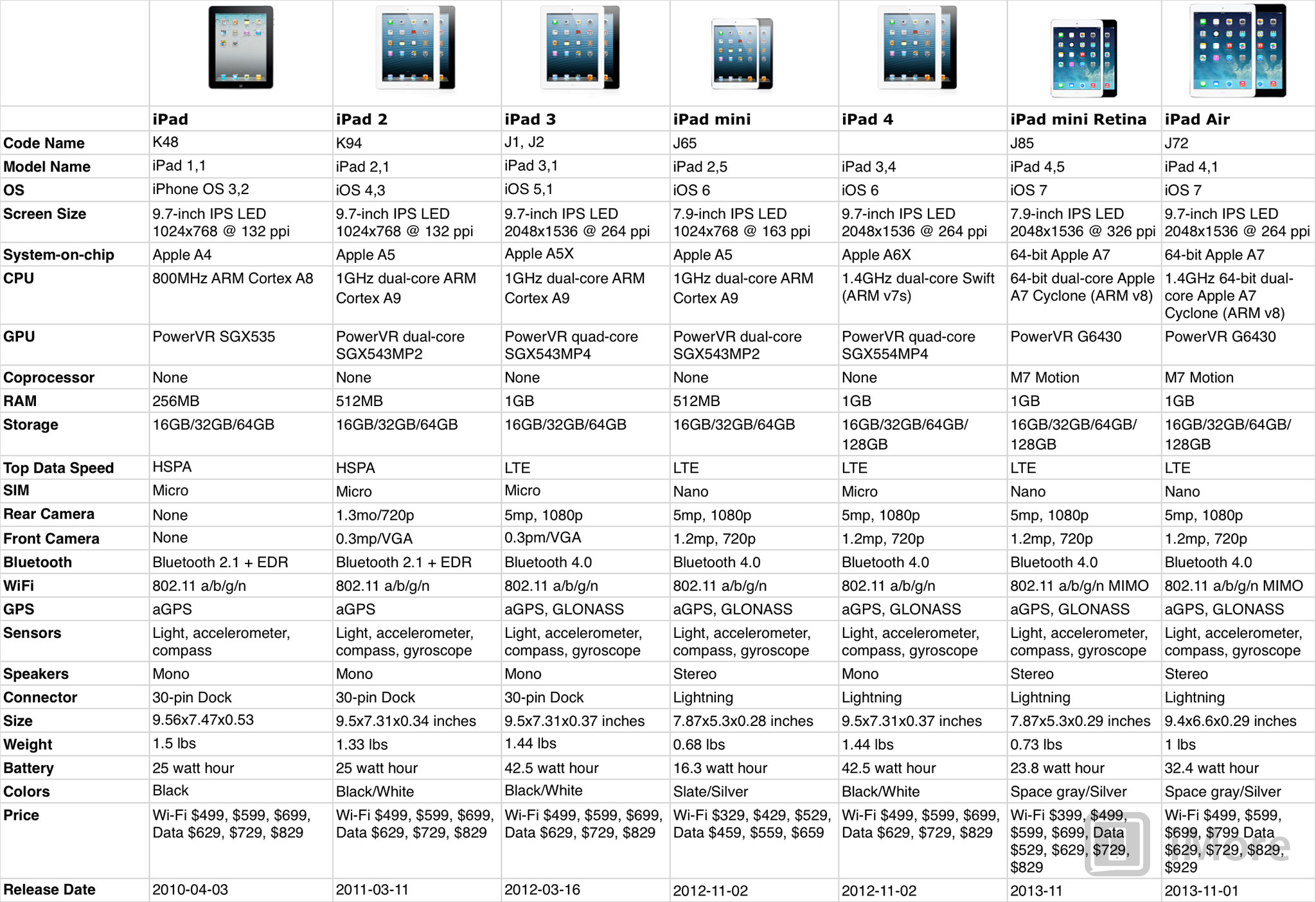
Since Steve Jobs first unveiled it at a special event in 2010, the iPad has improved steadily in one way or another. The iPad 2 was thinner, lighter, and faster. The iPad 3 got a Retina display and LTE. The iPad 4 went Lightning. The iPad mini dropped back to iPad 2 tech, but in a much smaller form factor. The above chart shows the evolution of the iPad from the original to the latest Retina iPad mini and iPad Air, including pricing and capacity at launch. While what you paid for it when you got it might vary, you can check your current model and see how it compares to the ones available now.
iPad Air and Retina iPad mini: Should you upgrade?
When a new iPad hits the market - or two iPads, as is the case right now - one of the hardest decisions we face is whether or not to upgrade from and original iPad, iPad 2, iPad 3, iPad mini, or iPad 4 to the latest and greatest. If you have unlimited funds, you can just buy everything, all the time. Most of us don't, however, so we need to check out the new features of the iPad Air or Retina iPad mini, see how they compare to what we already have, and decide if the difference is worth the price of an entirely new device, a price that starts at $399 and $499 and goes well up from there. So, is there enough value to justify the cost?
How to sell - and get the most money for! - your old iPad before upgrading to an iPad Air or Retina iPad mini
If you plan on upgrading to an iPad Air or Retina iPad mini, selling your old iPad is a no brainer. Apple products hold their resale value very well. If you've taken good care of your iPad, you should have no problem finding it a new home and putting some cash in your pocket while doing it. Selling the old really does help you afford the new. If you're not sure how to sell, or if you just want to make sure you get the most money, or save yourself the most time and effort, possible, here's everything you need to know!
iPad vs. Galaxy vs. Nexus vs. Kindle vs. Surface: Which tablet should you get?
Apple has flipped the tables - er, tablets - and not only managed to cram a 2048x1536 display into the 7.9-inch Retina iPad mini, but managed to cram a full-sized 9.7-inch display into the new iPad Air. But is either of them to right tablet for you? While everyone here at iMore certainly believes the iPad is still the best tablet for most people, most of the time, there are rare exceptions where an alternative tablet might suit your specific needs better. The iPad may have the best overall user experience, the highest quality apps and games, the widest range of services, the biggest selection of accessories, and the best customer support, but there are also things the iPad doesn't offer that other tablets do, like subsidized hardware pricing, digitizer support, Microsoft compatibility, or simply no Apple about them. How do you know which one is for you?
iPad Air vs. MacBook Air: Which Apple portable should you get?
Apple now has two products designated as "Air", the MacBook Air, updated last June with the latest generation Intel Haswell processors, and the brand new iPad Air, introduced in October with a custom Apple A7 chipset. Both are ultra light, super thin, and incredibly long lasting, but one has a keyboard and runs OS X and the other a multitouch and iOS 7. Both can be absolutely killer on a plane, in an office, or around the house. But which one is better for you?
iPad Air vs. Retina iPad mini vs. iPad 2 vs. iPad mini: Which iPad model should you get?
Once you're sure you're buying an iPad and now, the next step is to decide which iPad you're going to get. And this year, it's a tougher decision than ever. The new iPad Air and Retina iPad mini are identical in every way but screen size, 7.9- vs. 9.7-inches the only differentiator. If money is incredibly tight, though the old iPad 2 is a bit cheaper, and the old iPad mini, a cheaper still. No matter which one you choose, however, you'll be paying hundreds of dollars. Either a few, or a lot. So do you go with big or small, old or new? Which iPad should you get?
Silver vs. space gray: Which iPad Air and Retina iPad mini color should you get?
Unlike the pop-art inspired iPhone 5c, Apple's iPad line remains discreetly metallic when it comes to color schemes. It's not as bad as 2010, mind you, when you could have your choice of color, as long as it was black. Now you can get a silver back with white faceplate, or a space gray back with a black faceplate. And you can get either finish on either new iPad, the iPad Air or Retina iPad mini. (The space gray replaces last year's slate gray, likely because it's tougher and easier to anodize.) So which color is better for you?
16GB vs. 32GB vs. 64GB vs. 128GB: Which iPad Air or Retina iPad mini storage capacity should you get?
Apple offers four different storage sized options for the new iPad Air and Retina iPad mini, ranging from a paltry 16GB to an enormous 128GB - literally 8 times the capacity! Every step up in capacity, however, comes with a matching $100 step up in price. That might seem like a pretty straightforward bit of math, but it really isn't! Figuring out how much storage you really need, and how much you can afford is really important. It's the difference between a great experience and a lot of frustration. So what's the deal?
Speed vs. reliability vs. value: Which iPad Air or Retina iPad mini carrier should you get?
AT&T vs. Verizon vs. Sprint vs. T-Mobile in the U.S. Rogers vs. Bell vs. TELUS in Canada. Three vs O2 vs EE vs Vodafone in the U.K. And many more around the world. Then there are various discount carriers, regionals, and MVNOs. It's a mess! How do you know which carrier will give you the fastest data speeds, or the most reliable connections, or simply the best value for your money? It all comes down to where you live, work, or go to school, and what options work best in your specific area. However, there's a lot of broad generalities that can apply. Here are some of the most important, broken down by country!
Apple Store vs. other stores: Where should you buy your iPad Air or Retina iPad mini?
So now that you know what you're getting, how about where? Carrier compatibility aside, the iPad you get will be the same, but the customer service you receive can vary greatly. Also, if you have specific loyalty rewards at a certain carrier or company, that can change the deal you get.
Apple Retail: If you have an Apple Retail Store in your area, you can go there, and if it's in stock, leave with your new iPad right away. They also offer help with your purchase and will even help you get set your new iPhone up free of charge. If you're worried about protecting your investment, they can also get you setup with AppleCare, and their Genius Bar can help you with hardware problems in the future. Corny as it sounds, It's not just shopping, it's an experience. Apple Retail has the best customer service in the business and it shows. There are no discounts, however, not ever. (Though your carrier discounts can still apply.
Apple Online: If there's no Apple Retail store near you there's also Apple Online in many countries. Again, no discounts but you're dealing directly with Apple. If there are any shortages or shipping delays, you can still order and they'll get it out to you as soon as stock allows.
Carrier stores and big box retailers: If you want brick-and-morter but don't have an Apple Store nearby, your carrier will often have one or several stores in your area. If you want a cellular model, drop buy or get it shipped to you. Big box and chain retailers, everything from Best Buy to the Shack to Tesco also carry iPads. If you have loyalty points or they're just super convenient, check them out as well.
Shady operators also try to sell discount iPads, sometimes devices that aren't even really iPads but cheap -- and highly breakable -- knockoffs. It goes without saying you should avoid those. Any deal too good to be true probably is. If you save money only to end up with a phone that doesn't run iOS and may not even run on your carrier you really just wasted your money.
AppleCare+ vs. insurance vs. nothing: Which iPad Air or Retina iPad mini protection plan should you get?
If you plan on picking up a new iPad Air, a Retina iPad mini, or one of the cheaper, previous generation iPads, one of the last - but most important - things you have to decide is whether or not you'd like to get some kind of insurance to protect your investment, whether it be AppleCare+, third party, or something else. There are lots of factors that can play a part in your decision, such as how long you plan on keeping your iPad before upgrading, and how careful you are with it. Here's what you need to know!
If there's any detail you're still not 100% sure about, or any question you'd still love to get answered before you buy your brand new iPad Air or Retina iPad mini, we have fantastic information pages that are always kept up-to-the-minute, and amazing community forums filled with experts for you to talk with. Bookmark them and check back often! And once you've decided, let us know in the comments - which iPad did you get and why?

![[ Back to EurekAlert! ]](https://lh3.googleusercontent.com/blogger_img_proxy/AEn0k_szR-RN3XjvY24DQQmiKC0BFXVNJNkZXueQLF2iQwtZuBWyBTx36lF4y4l9SxoEZnXpMa9p0lNlpSzt3SrXfkp_ANtth4sJC6bLrxGvwLU=s0-d)
 Share
Share


 Source:


 Source: